A scientific result becomes easier to interpret when its sentence has a clear subject. An action, an experience and a personal aim are different subjects. Replacing one with another can make a modest, informative statement sound like a much larger promise. The first task is therefore grammatical as much as numerical: identify exactly what the evidence describes before deciding what importance to give it.
The discussion below develops an editorial distinction between means and ends. A means makes something possible; an end is the purpose for which someone might value it. Neither must erase the other. Carefully bounded research can inform a conversation in which the purpose remains personal. The fictional examples are exercises in reasoning, not accounts of treatment or claims about how commonly people feel a particular way.
Read the reported result
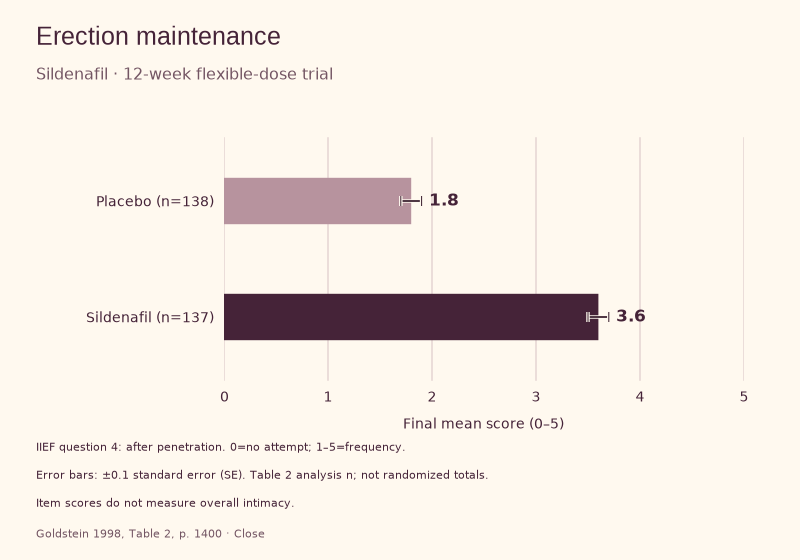
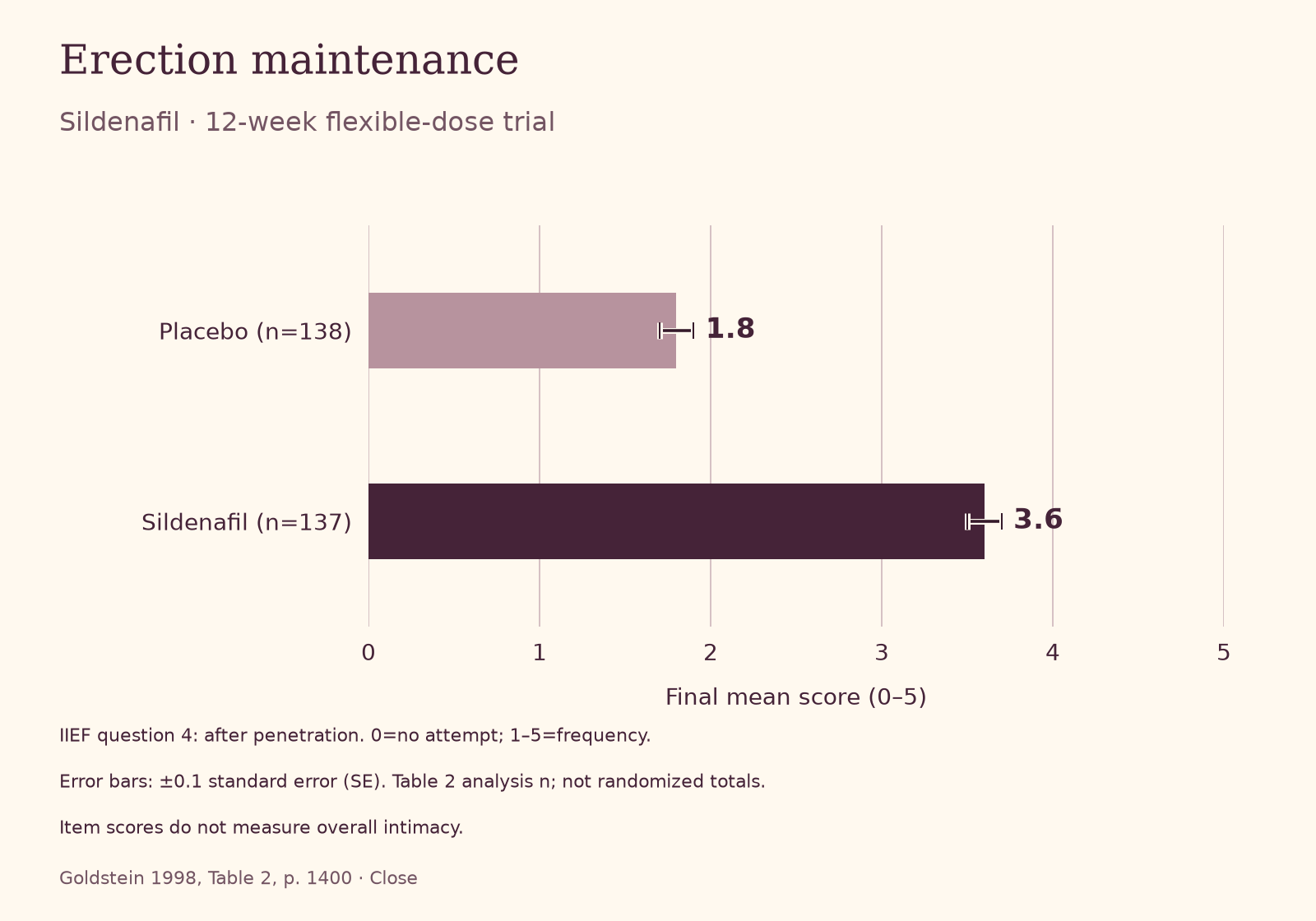
| Group | Mean ± SE | Analysis n |
|---|---|---|
| Placebo | 1.8 ± 0.1 | 138 |
| Sildenafil | 3.6 ± 0.1 | 137 |
Sildenafil, 12-week flexible-dose trial: final International Index of Erectile Function question 4 scores for maintaining erection after penetration. 0=no attempt; 1–5=frequency. SE=standard error.
Table 2 analysis n, not randomized totals. Item scores do not measure overall intimacy.
1Keep the subject inside the sentence
Goldstein’s randomized oral-treatment research involved men with erectile dysfunction. The chart isolates one functional item; the questionnaire also covered desire and satisfaction. Pfizer funded the research. Reported adverse effects included headache and flushing.
An operational definition states what will count as an observation. This is useful because another reader can inspect the same rule instead of guessing what a broad word meant. A defined action can be reported more consistently than an undefined idea of doing well. That gain in clarity belongs to the specified question, however; it does not supply definitions for every neighboring concern.
Consider the difference between describing an action and evaluating an occasion. The first sentence might concern something a person could do. The second might concern what that occasion meant to them. Both can be accurate, and neither is a translation of the other. Keeping their subjects visible allows evidence to contribute without silently deciding the purpose of the discussion. It also makes disagreements easier to locate: people may accept the same observation while assigning it different importance.
1A capability can serve more than one purpose
Imagine two fictional adults, Ellis and Ren. Ellis wants the possibility of a particular kind of sexual activity to remain available. Ren wants to understand a bodily concern before deciding whether that activity matters to them. These are invented priorities, with no medicine, outcome or clinical history assigned. The same question about physical capability could be relevant to both, yet for different reasons.
Their difference is not a contest over which concern is more legitimate. Ellis describes an option they value; Ren describes something they want clarified. Neither statement establishes a diagnosis or a treatment preference. The example shows why an investigator cannot infer a personal purpose merely by naming the action being measured. A capability may be useful precisely because its owner can decide whether and how to use it.
This distinction also leaves room for a purpose that is still unsettled. Someone can seek information before choosing an aim. Our guide to desire and erections offers a separate starting point for that conversation; the research question itself does not require the person to adopt an expectation about desire.
1Precise performance and a worthwhile occasion
Two ordinary examples help test the logic without making a medical claim. A baker can time how long bread takes to brown. A traveler can record how reliably a map leads to the correct address. Those observations have practical value. Yet browning time does not tell us whether the meal suited its occasion, and reaching an address does not tell us why the traveler wanted to be there.
The wider questions are not automatically more accurate because they are wider. They ask for additional information. The baker might care about feeding guests, learning a technique or making something familiar. The traveler might be collecting a parcel or seeing a friend. A narrow observation can contribute to each purpose while remaining the same kind of observation.
This is an analogy about reasoning, not a comparison between bodies and machines. Its point is that measurement and meaning can cooperate without becoming interchangeable. The table separates the roles they play. A precise answer may be highly relevant to a purpose; relevance alone does not make it a complete account of that purpose.
| Observation | Possible purpose | Additional question |
|---|---|---|
| Bread browning time | Prepare a meal for an occasion | Did the meal fit that occasion? |
| Accuracy of a map | Reach a chosen destination | Why did that destination matter? |
| Completion of a defined action | Keep an option available | What value does the person give that option? |
The unit of a number survives the calculation
A general rule of numerical interpretation is that a calculation inherits the subject of its inputs. Averaging responses about a defined action produces a summary of those responses. It does not create observations about a different subject. A new heading, a polished graphic or a more reassuring adjective cannot supply information that the inputs never contained. The meaning must travel with the number through every retelling.
Ordered response categories create a further distinction. They establish an order, but an order alone does not establish that every step represents an equal amount of lived difference. An average may still summarize coded responses; interpreting its magnitude requires attention to what the coding represents. This is a general measurement principle, not a new estimate or a reinterpretation of any participant’s experience.
The practical intellectual question is therefore not simply whether a number is large. It is large in what unit, answering which question? Keeping the unit attached prevents a statement about performance from quietly becoming a statement about personal worth. It also preserves the possibility that a technically small observation could matter greatly to someone for reasons the calculation does not describe.
1Two accounts can agree without becoming identical
Here are two further fictional descriptions, neither taken from a patient or study. In the first, a person says that an action has become easier and that the change matters to an activity they value. In the second, someone describes the same kind of easier action but says their central concern remains unresolved. These statements are logically compatible. They do not establish how often either pattern occurs or what caused it.
Calling the second account contradictory would require an extra premise: that easier action must settle the central concern. That premise is exactly what needs examination. Perhaps the concern was described too broadly, or perhaps it concerned something else from the beginning. The example does not choose an explanation. It simply shows why a conclusion about importance needs its own support.
The reverse also deserves care. A valued occasion need not prove that every component performed as hoped. People may describe an occasion using several considerations, without assigning them numerical weights. The discussion in more than a performance can help name that wider subject without converting it into a competing medical measure.
1Evidence of an effect and the value of an effect
Two questions often sit close together in scientific reading: whether an intervention made a difference, and whether a difference matters for a particular purpose. The first is a question about attribution. It asks what comparison can help distinguish an intervention’s contribution from other explanations. The second is a question about relevance. It asks how the resulting observation connects to the aim under discussion.
Strong reasoning on attribution does not remove the relevance question. Equally, a deeply important aim does not prove that an intervention advances it. Keeping these questions separate avoids two mistakes at once: dismissing useful evidence because it is incomplete, and treating persuasive evidence about one action as proof of every hoped-for consequence. An argument needs a justified connection at each step.
This is also why missing information should remain an open question. If an account does not establish a connection to a wider aim, that gap is neither evidence that the aim improved nor evidence that it failed. It identifies the additional observation a stronger claim would require. A reader can recognize the value of a result while leaving that larger claim undecided.
1Accurate reporting leaves room for a separate priority
A standardized question and an open conversation do different work. Changing the wording of a question to make it sound more personally meaningful can change what its answer means. A separate account of priorities can add context without requiring that alteration. This preserves a useful distinction between responding to the question asked and saying why the answer matters to the person responding.
For editorial purposes, imagine a short account with two ordinary sentences: one describes the concern in the speaker’s own terms; the other identifies what they would like help understanding. These are communication examples, not a replacement questionnaire or scoring system. No numerical total, diagnostic threshold or required sexual activity follows from them. A clinician remains responsible for interpreting health information and clinical measures.
The table illustrates kinds of statements rather than steps a reader must complete. Someone may be ready to describe an observation but undecided about its importance, or clear about a priority but unsure how to describe the concern. Our guide to a first sensitive appointment provides a separate place to begin that practical conversation.
| Kind of statement | Its contribution | Question left open |
|---|---|---|
| Description | Names an experience or concern | What explains it? |
| Priority | Identifies something the person values | What options are clinically appropriate? |
| Clinical interpretation | Assesses health and treatment context | Which acceptable option fits the person’s priorities? |
A meaningful aim does not settle medication safety
Viagra’s current labeling rules out use with nitrates or riociguat and calls for clinical consideration of cardiovascular health and interactions. Combining ED medicines is not recommended. An erection continuing beyond four hours requires emergency attention. For sudden loss or reduction of sight or hearing, stop the medicine and seek prompt care. If chest symptoms develop during sex, stop the activity, obtain immediate medical help and tell the treating team about recent use.
Those instructions answer a different question from whether a capability would be personally welcome. An attractive purpose cannot establish that a medicine is appropriate. Conversely, a clinical discussion of suitability need not define the person’s purpose for them. The relationship works best conceptually when both forms of information retain their role: the purpose explains why an option interests someone, while clinical assessment addresses whether and how care can proceed.
No preference statement can perform that assessment by itself. This is why a useful care question can remain conditional: what would need to be understood before considering an option relevant to this concern? The guide to private care and follow-up addresses the setting for asking such questions, separate from the interpretation of a research result.
2The object described in an offer needs its own evidence
Compounded preparations lack FDA approval. Before their marketing, FDA does not evaluate their quality, effectiveness or safety. They may address individual medical needs, while faulty quality or incomplete labeling can cause serious harm. Sharing an ingredient name does not establish equivalent evidence for a finished product.
Our editorial interpretation is that product documentation and personal purpose should be inspected independently. A person may have a clear aim and still need to know exactly what an offer describes. Likewise, detailed terms do not establish that the offer addresses that aim. Asking what each document supports helps prevent a chain of assumptions in which a familiar name substitutes for evidence at every step.
The Ro sildenafil review and Hims sildenafil review are navigation points for checking documentary terms. Their inclusion supplies no clinical outcome claim. The relevant reasoning question is whether the evidence being invoked concerns the same object as the offer being considered. Price language, access arrangements and descriptions of a preparation each need to be read for their own meaning; none becomes a scientific conclusion merely by appearing beside one.
3Let the next question preserve what remains undecided
A follow-up question can connect evidence and purpose without pretending the connection is already established. For example, a fictional speaker might ask how a clinician would interpret a particular concern given the speaker’s wish to keep an option available. That question identifies relevance while leaving the clinical answer open. It does not request a guaranteed experience or ask a number to settle the whole conversation.
An equally coherent speaker might say that their purpose is not yet clear. Information can still be useful in that situation. The next conversation may clarify the concern, explain a measurement or identify an uncertainty worth discussing. None requires a predetermined account of what intimacy should look like. The guide to starting the conversation offers language for opening that discussion.
Our companion analysis of daily tadalafil and normal-range language examines a different interpretive problem: the authority given to a technical category. The shared editorial question is how evidence can inform a person’s account without taking ownership of it. A good reading preserves both an observation’s precise meaning and the person’s freedom to explain its importance.
142Questions about the evidence
Does a precise measure make broader questions unscientific?
No. Precision concerns how a particular question is defined and answered. A broader question can also be investigated, but it needs suitable observations of its own. The error is to assume that precision about one subject supplies evidence about another subject automatically.
1Can a person value a capability without using it as a target?
Yes, as a matter of reasoning, valuing an available option does not require treating its use as an obligation. That is a statement about a possible preference, not an empirical finding about treatment, frequency of activity or how people ought to define intimacy.
1Why not combine everything into one personal success score?
A combined score would require decisions about which experiences to include and how much weight each receives. Inventing those rules would create a new measure without establishing what it means. Ordinary descriptions can keep several concerns visible without pretending that a total resolves them.
1Does an unresolved personal aim disprove a functional observation?
It need not. The observation and the aim may concern different things. An unresolved aim creates a further question about relevance or explanation; it does not logically erase an observation. Whether a particular account is clinically meaningful requires interpretation of its actual context.
12What makes a question useful when priorities are uncertain?
A useful question can identify what is uncertain rather than supplying a premature conclusion. Someone may want help describing the concern, interpreting information or understanding which options warrant discussion. These are possible conversational purposes, not evidence that any particular intervention will fulfill them.
2A useful question to carry forward
The central editorial argument is that a bounded observation can be useful without becoming a verdict. Scientific interpretation asks what the evidence establishes and what further connection a wider claim would need. Personal interpretation asks what the observation matters for. Clinical interpretation addresses health and treatment context. Giving each question its own space allows a reader to take evidence seriously while keeping the purpose of care open to an individual account.
Evidence access
Focused paper sections were examined; protocols, supplements and individual records were not.
The references behind this conversation
Each reference retains its original checked date. Later access attempts are listed separately; retrieving a page does not independently verify its claims. Provider material describes advertised services. Medical resources offer general context and do not endorse Close or its sponsors.
- Goldstein 1998Primary research · Originally checked
- Viagra prescribing informationOfficial prescribing information · Originally checked · Retrieved · Retrieved
- FDA: compounded drugsFDA guidance · Originally checked · Access unavailable · Not requested
- Porst 2006Study · Originally checked